Most floors that look like they need replacing actually need a repair. A squeak is a loose fastener, a peaked seam is a plank with nowhere to expand, a cracked tile is one tile over a spot that moves. We find the cause, fix it, and put the surface back so the repair blends in. This page walks through the problems we repair most in Leavenworth homes and how each one gets fixed.
Squeaky floors
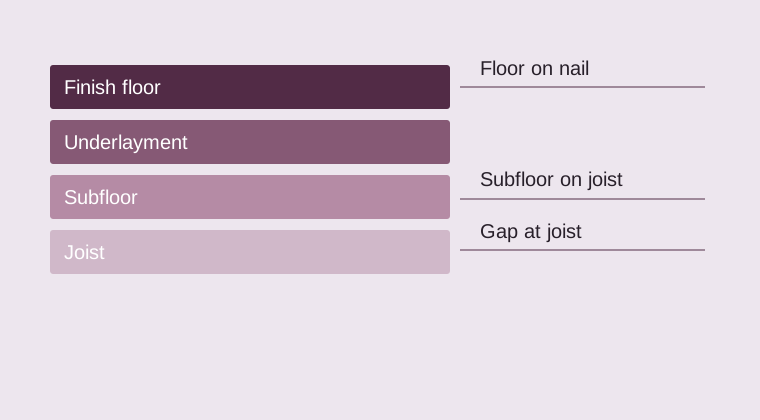
A squeak is two things rubbing that should not move. In most houses it is one of three spots:
- Finish boards rubbing on each other or sliding on a loose nail. Common in older hardwood, where nails have worked loose over decades.
- The subfloor lifting and dropping on its nails as you step on it, because the fasteners have loosened or the wood has shrunk around them.
- A gap between the subfloor and the top of a joist, so the subfloor flexes down onto the joist with each step.
There are two ways in. From below, when the floor sits over an open basement or crawl space, we can shim gaps and fasten the subfloor tight to the joists without touching the finished surface. From above, we use screws designed to snap off below the surface of carpet or wood, then fill and touch up. Which one fits depends on what is under the floor and whether the ceiling below is finished.
Vinyl plank and laminate that lifts, gaps or peaks
Floating plank floors are not nailed or glued down. They lock together and move as one sheet, which is why they fail in predictable ways:
- Peaking or tenting at the seams. The floor expanded and hit a wall, a cabinet or a door casing because the expansion gap around the edge was missing or got filled in later.
- Gaps opening between planks. The locking joint has worn or snapped, often in a doorway or in front of the sink where traffic is heaviest.
- A bouncy or clicking feel. The subfloor underneath is not flat, so planks flex over the low spots and the joints wear out.
- Edges swelling or cupping. Water got under or between planks. Laminate swells and does not recover; vinyl plank survives but traps the water under it. See water-damaged floor repair.
When the planks are undamaged, they can usually be taken up, the cause corrected (cut back the edge, flatten the low spot, dry the floor) and relaid. Damaged planks are replaced by working in from the nearest wall or by cutting out the single plank and setting a new one.
Hardwood
Solid and engineered hardwood repairs we see most:
- Damaged boards. Pet damage, a deep gouge, a burn or a stain that went through the finish. The damaged boards are cut out and new boards woven into the pattern so the joints stagger like the original.
- Loose or cupped boards. Usually moisture from below or a failed fastener. We find out which before refastening.
- Gaps between boards. In a heated house, wood dries out in winter and shrinks, so gaps open in January and close again by summer. Seasonal gaps like that are normal and usually do not need filling. Gaps that stay open all year, or keep widening, point to a moisture or subfloor problem.
Replacing boards is a repair. Sanding and refinishing a whole floor is a separate kind of job and not part of what this page covers.
Tile
- One cracked tile. If the tile is the only problem, it can be cut out and replaced without disturbing the ones around it, provided a matching tile can be found.
- Hollow or loose tiles. Tap a tile with a coin or a screwdriver handle. A hollow sound means the tile has lost its bond with the thinset underneath. One or two can be lifted and reset. A wide hollow area usually means the whole section needs to come up.
- Failed grout. Cracked or missing grout lets water through to the subfloor. It can be raked out and regrouted.
- A crack running across several tiles in a line. That is not a tile problem. Something underneath is moving: a seam in the subfloor, a joist, a soft area. Replacing the tiles without fixing what is under them just moves the crack. See subfloor repair.
Sheet vinyl and old resilient tile
Sheet vinyl tears, lifts at seams and edges, and bubbles where the adhesive has let go. A clean tear or a lifted seam can often be patched or reglued.
Older resilient flooring is different. In a house built before 1980, the 9-inch tiles, old sheet flooring backing and black adhesive can contain asbestos. The EPA says not to sand, scrape or drill material that may contain asbestos, and to have it sampled by a trained, accredited professional before a remodel disturbs it (EPA). If your floor is old and you are not sure what it is, mention it when you ask for a quote and send a photo. Our guide to subfloor problems in older Leavenworth homes has more on old flooring layers.
Transitions, thresholds and stair nosing
Where one floor meets another, the trim takes a beating. Transition strips crack, lift or come loose from their track; thresholds wear through at exterior doors; stair nosing pulls away at the edge of a plank-floored landing. These are small repairs, but they are also trip hazards, so they are worth fixing early.
Matching
Matching decides whether a repair blends in or looks like a patch.
- Hardwood is the easiest: most common species and widths are still milled, and a matched stain gets close. Very old floors have a patina new wood will not have on day one.
- Vinyl plank and laminate lines are discontinued often. If you kept a box of spare planks, it is worth digging out. If not, we can sometimes borrow planks from inside a closet or under an appliance and put the replacement where it will not be seen.
- Tile is the hardest. Dye lots change, and a tile from a different batch can be visibly off.
When a true match is not possible, we lay out the options plainly: a close match in a low-traffic spot, a deliberate border or transition, or replacing the room.
When repair becomes replacement
A floor is usually worth replacing rather than repairing when:
- the repair would cost about half or more of what a new floor in that room would cost
- the damage covers most of the room rather than one area
- the material cannot be matched and the patch would be obvious
- the floor has warped badly or the subfloor under a large part of it needs work
- the floor is engineered hardwood that has already been sanded down, or laminate or vinyl that cannot be refinished
Angi uses the same half-the-cost test in its floor repair cost guide. When we quote a replacement, it means taking up the damaged floor, fixing what is underneath, and putting a floor back down in that room. Our cost guide compares typical repair and replacement figures.
What we need for a quote
- Photos of the problem up close, and one of the whole room
- The approximate size of the room
- What the floor is, if you know (hardwood, vinyl plank, laminate, tile, sheet vinyl)
- What is under it, if you know (basement, crawl space, slab)
- How long it has been happening, and whether there has been a leak
Floor repair questions
Can you fix a squeak without pulling up the carpet? Usually. If there is a basement or crawl space underneath, we fix it from below. If not, there are screws made to go through carpet and pad into the joist and snap off below the backing, so the carpet stays down.
Why does my floor only gap in winter? Heated indoor air is dry, so wood gives up moisture and shrinks. Gaps that open in the cold months and close again by summer are normal seasonal movement. If gaps stay open in July, something else is going on.
Can one cracked tile be replaced? Yes, if a matching tile is available and the crack is not caused by movement underneath. If the crack continues into the next tile, the floor below needs a look first.
Do I need a permit to repair a floor in Leavenworth? The City of Leavenworth lists tiling, carpeting and similar finish work among the jobs that do not need a building permit (City of Leavenworth inspections FAQ). Structural work such as repairing joists is a different matter, and separate plumbing or electrical permits can still apply. Check with the city's Inspections Division if your job goes past the floor surface.
Get a Quote
Tell us what your floor is doing and send a few photos. You get a written repair quote back.
Related: flooring repair home · subfloor repair · water-damaged floors · flooring cost guide