Short answer: a slope that has been the same for decades is usually just the house. A soft spot, a new dip, or a crack that keeps growing is a repair. Most old-house floor problems fall clearly on one side of that line once you know what to look for.
How old the houses are
According to the Census Bureau's American Community Survey, 27.8% of housing units in the city of Leavenworth were built before 1940, and 62.2% before 1980 (U.S. Census Bureau, ACS 2024 five-year, table B25034). That means most Leavenworth floors sit on framing and subfloors put down well before modern plywood standards, and many have been covered over more than once since.
What is under an old floor
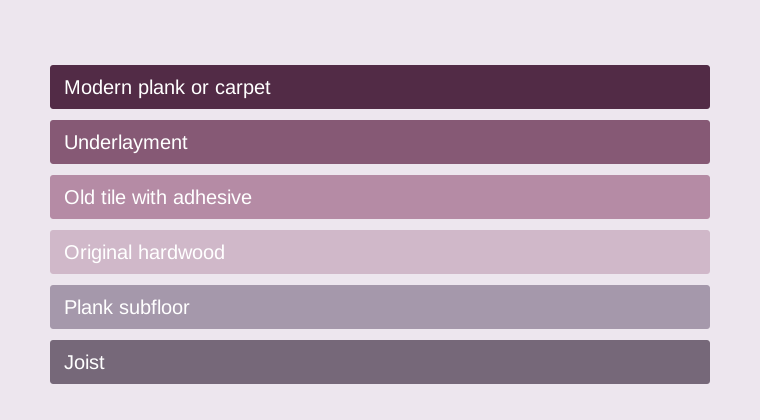
From the bottom up, a typical older Leavenworth floor looks something like this:
- Joists, often full-dimension lumber in very old houses, sometimes notched or patched over the years for plumbing and wiring.
- A plank subfloor, solid boards laid straight across the joists or on a diagonal. Diagonal planks were a common way to stiffen a floor before sheet subfloors.
- Original finish flooring, frequently hardwood, sometimes painted softwood.
- Later layers: sheet vinyl or resilient tile glued on, then perhaps a plywood underlayment, then carpet or vinyl plank on top.
Each layer added height and weight, and each one may have been put down over problems in the layer beneath it.
Normal vs. not
| What you notice | What it usually means | What to do |
|---|---|---|
| Gentle slope across a room that has not changed in years | The house settled long ago | Usually nothing; account for it when new flooring goes down |
| A dip in one spot, especially near a bathroom or kitchen | Soft or rotted subfloor | Have it opened and checked; see subfloor repair |
| Bouncy floor across the middle of a room | Long joist spans, or joists weakened by old notches | Have the framing looked at from below |
| Squeaks everywhere | Loose nails in old boards and plank subfloor | A repair, often from below |
| A crack in tile or plaster that keeps growing | Something is still moving | Find out what before repairing the surface |
| Doors that suddenly stick or swing on their own | Recent movement in the framing or foundation | Call a structural contractor or engineer |
| Floor higher in the middle of the house than at the walls | A center beam or posts holding up while outer walls settled | Common in old houses; check that posts are sound |
Old flooring layers and asbestos
Old resilient flooring is common in Leavenworth houses: 9-inch square tiles, sheet flooring with a felt backing, and the black adhesive that held them down. In houses built before 1980, these materials may contain asbestos.
The EPA's guidance is straightforward. Undamaged material that is left alone is generally not a health risk. Do not sand, scrape, saw or drill it, and never use a power stripper on flooring that may contain asbestos. If you plan to remodel or the material is damaged, have it sampled by a trained, accredited professional rather than taking a sample yourself. When flooring needs replacing, covering the old material is often the best option (EPA).
In practice, that means if you pull up carpet or vinyl plank and find old tile underneath, stop, take a photo and do not start scraping.
Squeaks in old floors
Old floors squeak because nails loosen as boards shrink and swell through a century of seasons, and because plank subfloors rub at their edges. The good news is that old floors over an open basement are often the easiest to quiet: the subfloor can be fastened up to the joists from underneath. See squeaky floor repair.
Flattening an old floor for new flooring
Modern plank and tile need a flat, stiff base. Shaw's resilient flooring guidelines, for example, allow no more than 3/16 inch of deviation over 10 feet (Shaw). An old floor can usually be brought within that range locally: humps planed down, low spots filled, a new layer of plywood screwed over a plank subfloor. What flooring prep cannot do is make a settled house level. The realistic goal is a floor that is flat, even if it still runs slightly downhill.
Moisture from below
Old houses in Leavenworth sit on a mix of crawl spaces and stone, brick or block basements. Moisture rising from a damp crawl space or basement keeps the subfloor damp, which feeds rot and makes floors cup and squeak. Fix the moisture first. Our guide to basement flooring and moisture covers how to check for it.
When to call a structural contractor instead
A floor repairer works on the floor. Call a structural contractor or an engineer instead when you see:
- a sag that runs the length of a joist or beam
- cracked, split or rotted joists or posts
- new cracks in the foundation or basement walls
- doors and windows that have started sticking in the last year
- a floor that keeps getting worse after it has been repaired
Sources
- U.S. Census Bureau, ACS 2024 five-year estimates, B25034 year structure built
- EPA, protect your family from exposures to asbestos
- Shaw, commercial resilient installation guidelines
Get a Quote
Something under your floor not right? Send photos of the problem and tell us roughly when the house was built. We will reply with a written quote.
Related: floor repair cost guide