Short answer: check the slab for moisture before anything goes down, choose a floor that tolerates some moisture, and never trap water under a floor that cannot take it. Most basement floor failures are moisture problems that were there before the floor was.
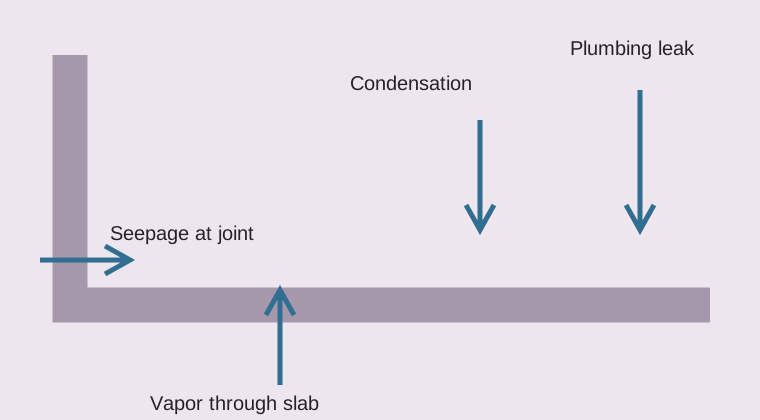
Where basement moisture comes from
- Vapor through the slab. Concrete is porous. Ground moisture moves up through it all the time, even when the surface looks dry. Older slabs often have no vapor barrier underneath at all.
- Seepage at the wall joint. Water running down the outside of a foundation wall finds the joint between the wall and the floor and comes in at the edges.
- Condensation. In humid Kansas summers, warm air hits a cool slab and the floor sweats, especially under rugs and furniture.
- Plumbing. Water heaters, washers, softeners and floor drains that back up.
Simple checks a homeowner can do
- The taped plastic sheet test. Tape a square of clear plastic sheeting, about two feet on a side, flat to the slab on all four edges. Leave it for a day or two. Moisture on the underside of the plastic means water is coming up through the slab. Moisture on top means the room air is condensing on a cool floor.
- White, crusty deposits on the slab or the bottom of the walls are minerals left behind by water moving through the concrete.
- A musty smell after rain, or damp carpet pad at the edges of the room.
- Rust on metal furniture feet, tool chests or water heater bases.
These checks tell you whether you have a problem. They do not tell you how much.
How pros measure
Flooring manufacturers name the tests they require in their installation guides, and their warranties depend on them. Shaw's residential resilient guidelines, for example, call for concrete to be tested for internal relative humidity under ASTM F2170, with calcium chloride testing under ASTM F1869 as an optional additional test (Shaw). Shaw's guidelines for its rigid-core vinyl set the limits at 8 pounds by the calcium chloride method or 90% relative humidity by F2170, and say not to put the flooring over concrete with a history of high moisture (Shaw SPC guidelines). Limits vary by product, so the guide for the floor you are actually buying is the one that counts.
Floors that tolerate a basement, and floors that do not
| Floor | In a basement | Why |
|---|---|---|
| Vinyl plank (rigid core) | Usually a good choice | The plank does not absorb water; can be taken up and relaid after a leak |
| Tile | Good choice on a sound slab | Unaffected by water; needs a flat, crack-stable slab |
| Sealed or painted concrete | Good choice | Nothing to rot or swell |
| Laminate | Poor choice | Fiberboard core swells with moisture |
| Solid hardwood | Avoid | Absorbs moisture from the slab, cups and buckles |
| Engineered hardwood | Only with the maker's approval and testing | More stable than solid, still wood |
| Carpet with pad | Risky | Pad holds moisture against the slab; musty smells and mold follow |
For more on the plank choice, see LVP vs. laminate.
Old basements
Many older Leavenworth houses have stone, brick or block foundation walls and slabs that were poured thin, patched over the years, painted, or never quite flat. Common issues:
- Uneven or cracked slabs that need grinding or leveling compound before plank or tile goes down
- Painted slabs where the paint is peeling, often a sign of moisture pushing up from below
- Old tile and black adhesive on the slab. In a house built before 1980, these may contain asbestos. The EPA advises leaving undamaged material alone, covering it when possible, and having it sampled by an accredited professional before it is sanded, scraped or removed (EPA). More on that in our guide to subfloor problems in older homes.
Fix the water first
No floor fixes a wet basement. Before any new flooring, deal with the source: gutters and downspouts that dump next to the foundation, ground that slopes toward the house, a sump pump that is missing or failing, cracks that let water in. We are not a waterproofing company. If water is coming in at the walls or the floor after rain, call a basement waterproofing contractor before you spend money on flooring.
After a basement gets wet
If your basement floor has already taken on water from a leak or a backup, the steps are different: dry it, find out what is damaged, then decide. Our water-damaged floor repair page covers what can be saved. Our cost guide shows published repair and replacement ranges.
Sources
- Shaw, residential resilient installation guidelines
- Shaw, resilient installation guidelines for SPC products
- EPA, protect your family from exposures to asbestos
Get a Quote
Basement floor lifting, damaged or wet? Get a repair quote. Send photos of the floor and the room.