Short answer: for kitchens, bathrooms, laundry rooms and basements, choose luxury vinyl plank (LVP). For dry living areas and bedrooms, where scratch resistance and a firmer, more wood-like feel matter, laminate is a fair choice. The difference comes down to what is inside the plank.
What each one is made of
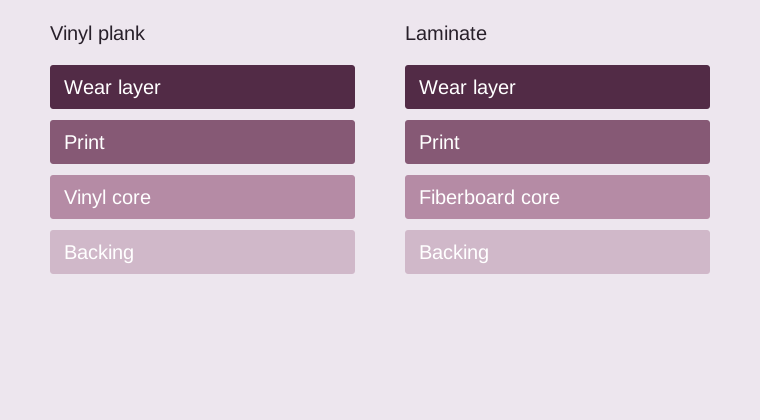
Both are layered planks with a printed photo of wood on top and a clear wear layer over it. The core is where they part ways.
- Luxury vinyl plank has a plastic core. On rigid-core products that core is mixed with stone powder (often sold as SPC) or foamed (WPC). Plastic does not absorb water.
- Laminate has a core of high-density fiberboard: wood fibers pressed with resin. It is hard and stable when dry, and it swells when water gets into it.
Almost every difference below follows from that.
Water
Vinyl plank shrugs off a spill or a leak; the planks themselves will not swell. Laminate's surface resists spills that are wiped up, and many newer laminates have sealed edges, but water that sits in a joint or gets under the floor reaches the fiberboard and the edges swell for good.
Two cautions about the word "waterproof" on a box:
- It describes the plank, not the floor. Water that runs between vinyl planks ends up on the subfloor, where it can sit for weeks and rot wood or feed mold. The plank survives; what is under it may not.
- Warranties have limits. Read the water terms before you buy. Shaw's installation guidelines for its rigid-core vinyl, for example, state that Shaw does not warrant damage from moisture-related issues and set moisture limits for concrete underneath (Shaw SPC installation guidelines). Laminate makers that advertise water resistance attach their own conditions too, so read the specific product's warranty, not the front of the box.
Scratches, dents and pets
Laminate has a very hard melamine wear surface, which makes it good at resisting scratches from claws and grit. Vinyl's wear layer is softer; thicker wear layers hold up better, and cheap thin ones scuff. On the other hand, vinyl handles water from a dog bowl or an accident far better than laminate does. Heavy furniture can dent either one, so use wide pads under feet.
Feel, sound and temperature underfoot
Laminate feels firmer and a bit more like wood. Vinyl, especially thinner glue-down products, feels softer and can feel cooler on a concrete slab. Both can sound hollow or clicky if they float over an uneven subfloor or a cheap underlayment; a good underlayment and a flat floor make a bigger difference than the brand.
How each one fails, and whether it can be repaired
This is the part that matters after year three.
Vinyl plank usually fails at the joints: a click lock wears out in a doorway, planks pull apart, or a plank peaks where the floor had no room to expand. Individual planks can be replaced. In a floating floor, that means unlocking rows from the nearest wall or cutting out the damaged plank and setting a new one in with adhesive.
Laminate usually fails from water: edges swell along a dishwasher or fridge line. Swollen planks do not recover and have to be replaced, using the same methods as vinyl.
In both cases, the hard part is matching. Plank lines are discontinued often. Keep at least one unopened box of spare planks in the house; it is the cheapest insurance a plank floor has. More on repairs on our floor repair page.
Subfloor demands
Neither product forgives an uneven floor. Floating planks bridge over low spots, flex every time someone steps there, and the joints wear out. Manufacturers set limits: Shaw's resilient guidelines call for no more than 3/16 inch of deviation over 10 feet (Shaw). In older Leavenworth houses with plank subfloors, getting there is often more work than the flooring itself.
Cost
HomeAdvisor puts vinyl at $2 to $14 per square foot and laminate at $3 to $13 per square foot, materials and labor together (HomeAdvisor). The ranges overlap heavily; the product line matters more than the category. Repairs run in similar ranges too: Angi lists vinyl repairs at $300 to $1,850 and laminate repairs at $400 to $2,125 (Angi). See our flooring cost guide for more.
Room-by-room pick
| Room | Pick | Why |
|---|---|---|
| Kitchen | Vinyl plank | Dishwasher, sink and fridge lines are where laminate swells |
| Full bathroom | Vinyl plank (or tile) | Water on the floor is routine |
| Laundry room | Vinyl plank | Washer leaks happen without warning |
| Basement | Vinyl plank | Slabs give off moisture; laminate's core does not tolerate it. See basement flooring and moisture |
| Living room | Either | Laminate if scratch resistance matters most |
| Bedrooms | Either | Laminate feels firmer; vinyl is quieter with a good underlayment |
| Entry from outside | Vinyl plank | Wet boots and tracked-in snow melt |
| Rental unit | Vinyl plank | Water tolerance and plank-by-plank repairs. See rental flooring |
Rentals
For a rental, the question is not which floor looks best on day one but which floor you can fix cheaply between tenants. Our guide to rental flooring and PCS move-outs covers that in detail.
Sources
- Shaw, resilient installation guidelines for SPC products
- Shaw, commercial resilient installation guidelines
- HomeAdvisor, flooring installation cost
- Angi, floor repair cost guide
Get a Quote
Have a plank floor that is lifting or damaged? Get a repair quote. Send photos of the problem and the room.