A dishwasher line lets go, a toilet overflows, a water heater leaks into the basement. Whatever the source, the floor takes the hit, and what you do in the first day decides how much of it can be saved. Below is what to do now, what water does to each kind of floor, and how the repair goes once things are dry.
Do this first
- Stop the water. Shut off the fixture valve or the main. If water is near outlets or cords, turn off that circuit.
- Take photos of the water, the source and the floor before you move anything. Your insurer will want them.
- Get standing water up with towels, a wet vacuum or a mop. Pull up area rugs and move furniture off wet flooring.
- Get air moving. Fans and a dehumidifier help, and opening the house on a dry day does too.
- Call your insurer if it looks like a covered loss, before anything is torn out.
We repair floors after the water is stopped and things are drying. We are not an emergency water extraction company and do not offer 24-hour response; for a large flood, call a water mitigation company first.
What water does to each floor
- Hardwood absorbs water and swells. The edges of each board rise higher than the middle (cupping). If the top dries faster than the bottom, boards can later crown, high in the middle. In bad cases the whole floor pushes up off the subfloor (buckling).
- Laminate has a fiberboard core. Once water reaches it, the edges swell and stay swollen. That damage does not go back down when it dries.
- Vinyl plank is not harmed by water itself, but water that gets between or under planks has nowhere to go. It sits on the subfloor, which is where the real damage happens.
- Tile survives water well. The grout and the subfloor under it may not, especially on a wood subfloor.
- Carpet and pad soak water up like a sponge. Pad usually has to be replaced; the carpet sometimes can be saved if it is dried quickly and the water was clean.
Dry first, decide second
A wet floor is not repaired while it is wet. Wood floors and wood subfloors change shape as they take on and give up water, and a floor that is sanded flat or refastened while it is still damp will move again once it dries. The floor and the subfloor under it both have to come back to normal moisture levels before anyone decides what can stay. For hardwood, that can mean waiting days or weeks with fans and dehumidifiers running, and checking the wood with a moisture meter instead of guessing by touch.
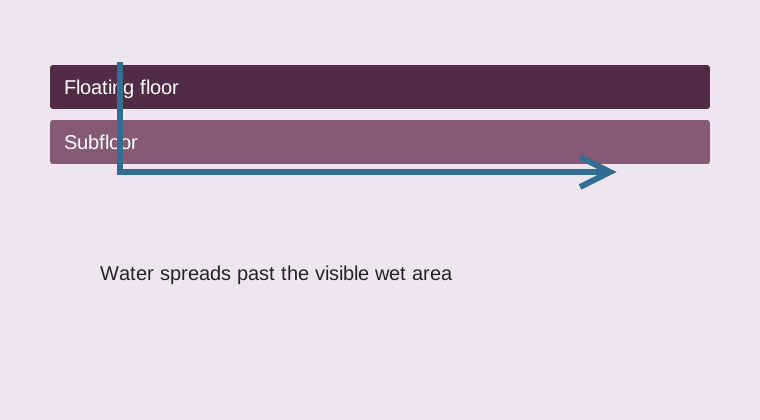
Under a floating floor (vinyl plank or laminate), the water has to be reached. Planks near the wet area usually have to come up so the subfloor can dry.
What can be saved and what cannot
- Hardwood that cupped but dried back down can often be refastened or lightly repaired. Boards that cracked, split or stayed badly cupped are replaced.
- Laminate with swollen edges is replaced. The good news is that only the swollen planks need to go, if matching planks can be found.
- Vinyl plank can usually be taken up, dried and relaid, because the planks themselves are fine.
- Tile stays unless the subfloor under it was damaged or the tile lost its bond.
- Carpet pad almost always goes.
The subfloor after a leak
The finished floor is the part you see, but the subfloor is the part that matters. Plywood and OSB that stayed wet for days can delaminate, swell or start to rot. If the subfloor feels soft, has swollen at the seams, or has dark staining when the floor is opened, it needs subfloor repair before a new surface goes on top.
Mold
Mold is not a flooring problem, and a floor should not be closed up over it. If you see growth on the subfloor or the back of the flooring, or the area smells musty after it has dried, have that assessed and dealt with before the floor is put back.
Working alongside an insurance claim
If you have a claim open, your adjuster will want to know what the damage is and what it will take to fix it. We can give you a written quote that describes the floor repair and what needs to be removed and replaced. What the policy pays is between you and your insurer; we do not make promises about claim outcomes.
Cost
Angi lists water damage floor repair at $200 to $6,300 (Angi). The low end is a few planks of vinyl relaid; the high end is a room of hardwood and the subfloor under it. Our flooring cost guide shows how the type of floor and the depth of the damage move the number. If the leak was in a basement, our guide to basement flooring and moisture covers what to fix before any floor goes back down.
Water damage questions
Will a cupped hardwood floor flatten out? Often it will, partly or fully, once the source is gone and the wood dries back down. That is why sanding a cupped floor right away is a mistake: sand it flat while it is wet and it will crown when it dries.
Can you replace only the wet area? Usually, yes. With hardwood we cut out and weave in new boards; with vinyl plank and laminate we replace planks from the nearest edge. The catch is matching, which is easier with hardwood than with discontinued plank lines.
How long after a leak can the floor be repaired? When the floor and subfloor have dried back to normal. For a small leak caught quickly, that can be a few days. For hardwood that soaked overnight, it can be a few weeks. Repairing too soon is the most common reason a water-damaged floor fails twice.
Get a Quote
Had a leak? Send photos of the damage and the room, and tell us when it happened. We will reply with a written quote for the repair.
Related: Leavenworth Flooring home · floor repair · subfloor repair · what floor repair costs