A soft spot in a floor is almost never the flooring. It is the subfloor, the layer of plywood, OSB or wood planks that the finished floor sits on, and it has gone soft because water has been getting to it. Lay a new floor over it and the new floor flexes, cracks or lifts in the same place. The fix is to open the floor, stop the source, replace the bad wood and build back up to a flat, solid surface.
Signs it is the subfloor
- The floor feels soft, spongy or bouncy in one area
- There is a dip you can see or feel underfoot
- Tile has cracked in a line, or grout keeps cracking in the same place
- A toilet rocks, or the floor around it gives when you stand next to it
- Vinyl plank seams keep opening in one spot
- A musty smell that is stronger near the floor, or staining on the ceiling below
Any one of these is worth a look. Two together usually means rot.
Where it happens
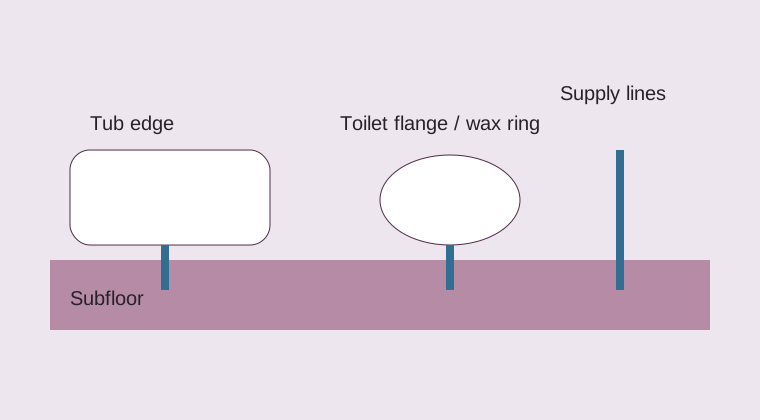
Subfloor damage follows water. In Leavenworth homes we see it most:
- Around toilets, from a failed wax ring or a supply line that dripped for months
- Along tub and shower edges, where water gets past caulk or a cracked surround
- In front of the dishwasher and the kitchen sink
- Under a refrigerator with an ice maker line
- At exterior doors, where rain blows in under a worn threshold
- Over a damp crawl space or basement, where moisture rises into the wood from below
Old houses, old subfloors
Many Leavenworth houses are old enough that the subfloor is not plywood at all. In homes built before the 1950s or so, it is often solid wood planks, laid straight across the joists or on a diagonal. Plank subfloors are strong, but the boards shrink and gap over time, edges cup, and nails loosen. On top of them you may find several generations of flooring: original hardwood, then sheet goods, then carpet or plank.
Some of what you feel in an old floor is the house itself. A gentle slope from one side of a room to the other that has been there for decades is usually settling, not a failing floor. What can be fixed at the floor level is a soft area, a dip in one spot, loose or broken planks, and a surface that is uneven enough to ruin new flooring. Our guide to subfloor problems in older Leavenworth homes goes deeper on telling the two apart.
How the repair goes
- Open it. Take up the finished floor over the damaged area and a margin past it.
- Find the source. A rotted subfloor has a reason. If the toilet seal, the supply line or the threshold is still leaking, a new subfloor will rot the same way. The leak gets stopped first.
- Cut back to sound wood. Soft wood is cut out until the edges are solid, with the cut lines landing over joists or with new blocking added so every edge is supported.
- Replace and fasten. New subfloor material matched to the thickness of the old, glued and screwed down.
- Flatten. Seams and transitions brought level with the surrounding floor so the finish floor sits flat.
- Close it up. A finish floor goes back down, matched to the room where possible.
When it is more than subfloor
Sometimes the soft spot goes deeper. The joists that carry the subfloor can rot along the top where water sat on them, a joist can be cracked or notched, and in a basement a beam or post can settle. Signs that the problem is structural rather than a subfloor repair:
- the dip spans several feet and runs along the length of a joist
- the joist feels soft when probed, or is cracked or split
- doors nearby stick or have started to swing on their own
- the floor has kept getting worse over months
- there are cracks in the foundation or basement walls below
If an opened floor shows damage like that, it needs a structural contractor or an engineer to assess it before anything is closed back up. We will show you what we found and why it matters.
Getting a floor flat enough for new flooring
Flooring manufacturers set flatness limits, and they mean them. Shaw's published resilient flooring guidelines, for example, call for no more than 3/16 inch of deviation over 10 feet, or 1/8 inch over 6 feet (Shaw resilient installation guidelines). A floor that misses that range is why plank floors click, bounce and break at the joints within a year or two. Tile needs a subfloor that is both flat and stiff. Part of any subfloor repair is bringing the area back within the range your flooring needs.
Cost
Angi lists subfloor repair at $900 to $3,000, and sagging or uneven floors at $1,000 to $8,500 (Angi). HomeAdvisor puts subfloor replacement at $3 to $10 per square foot, including removal and disposal (HomeAdvisor). The size of the soft area, whether cabinets or a tub sit on it, and what the finish floor is all move the number. Our flooring cost guide has the full breakdown.
Subfloor questions
Can you replace subfloor without removing the cabinets or tub? Often. Subfloor can usually be cut back to the face of a cabinet or the edge of a tub, with new blocking to support the cut edge. If the rot has run under the cabinet or tub, the fixture has to come out to reach it, and we will tell you that before the quote is final.
Is a sloping floor in an old house a problem? Not by itself. Most old houses have settled, and a slope that has been stable for years is usually just the house. A slope that is getting worse, a soft area, or new cracks in walls or tile are the signs to have it checked.
Will insurance cover a rotted subfloor? It depends on your policy and on the cause. Many policies treat a sudden leak differently from damage that built up slowly over time. Call your insurer before the floor is torn out, and take photos. We do not make promises about what a claim will pay.
Get a Quote
Feel a soft spot? Send a photo of the area and the room around it, and we will tell you what we think is going on.
Related: Leavenworth Flooring home · floor repair · water-damaged floors · repair cost guide