Short answer for tenants: most floor damage in a rental is a small repair if you deal with it a few weeks before the walkthrough instead of the day before.
Short answer for landlords: choose floors you can repair one plank or one board at a time, keep spare material on hand, and document the floors at every move-in and move-out.
The Leavenworth calendar
Leavenworth is a renter's town. About half of the city's households rent their homes (U.S. Census Bureau, ACS 2024 five-year, table B25003). Fort Leavenworth shapes the timing: the Army's busy moving season runs from May 15 through August 31 (U.S. Army), and off-post leases in Leavenworth and Lansing turn over in the same weeks. That puts a lot of walkthroughs, repairs and new move-ins into one summer stretch.
This guide covers off-post rentals: houses, duplexes and apartments in town.
For tenants: what is usually repairable before the walkthrough
- Lifted or separated vinyl plank. Often the planks can be taken up and relaid, or the damaged ones swapped out, especially if the landlord left spare planks in the unit.
- A gouged or stained hardwood board. The damaged board can be cut out and a new one woven in.
- A chipped or cracked tile. One tile can be replaced if a match exists.
- Loose or broken transition strips between rooms, and lifted edges where carpet meets a hard floor.
- Pet damage in one area. Scratched planks near a door, a stained spot. Often a few planks or boards.
What is usually not a quick fix: laminate that swelled from water across a large area, carpet with widespread pet damage, or a soft subfloor under a bathroom floor. Those are bigger repairs (see water-damaged floor repair), and in many cases they are not the tenant's damage in the first place.
Damage vs. ordinary use
Kansas law sets the rules for security deposits. Under K.S.A. 58-2550, a landlord may apply the deposit to unpaid rent and to damages the landlord suffered because the tenant did not meet the tenant's obligations, "all as itemized by the landlord in a written notice delivered to the tenant." The landlord must return the balance within 14 days after determining the amount owed, and in no case more than 30 days after the tenancy ends, possession is delivered and the tenant has asked for it (K.S.A. 58-2550).
In flooring terms, worn traffic paths and faded finish from years of normal living are a different thing from a gouged board, a burn mark or a floor ruined by an unreported leak. Where your floor falls is between you and your landlord. This is general information, not legal advice; if you are in a dispute, read the statute and your lease, or talk to a lawyer.
For landlords: repair or replace between tenants
Between tenants, the question is whether the floor will survive another lease. Some rules of thumb:
- Repair when damage is limited to an area, the material can be matched, and the rest of the floor has life left in it.
- Replace when damage covers most of the room, the floor has been patched repeatedly, the material is discontinued, or the subfloor is soft.
- Fix the cause. A plank floor that keeps separating in a doorway, or a bathroom floor that keeps getting soft at the toilet, will fail again under the next tenant if the cause is not fixed.
Turnover windows are short, so get photos to a flooring repairer as soon as you know a unit is coming open. Our floor repair page covers the common repairs, and the cost guide shows published price ranges.
Floors that survive tenants
When a rental floor does need replacing, these are the qualities that pay off over several leases:
- Repairable one piece at a time. Vinyl plank and hardwood can be fixed board by board. Wall-to-wall carpet with a pet stain is hard to patch invisibly.
- Water tolerant. In kitchens, baths, laundry rooms and basements, vinyl plank holds up where laminate swells. See LVP vs. laminate.
- Pet tolerant. A thicker wear layer resists scratches; a darker, busier pattern hides wear.
- A common product line. A floor that is likely to stay in production is easier to match later.
- Spare material on site. Keep at least one unopened box of the exact flooring in the unit or in storage. It turns a replacement into a repair.
Documenting floors at move-in and move-out
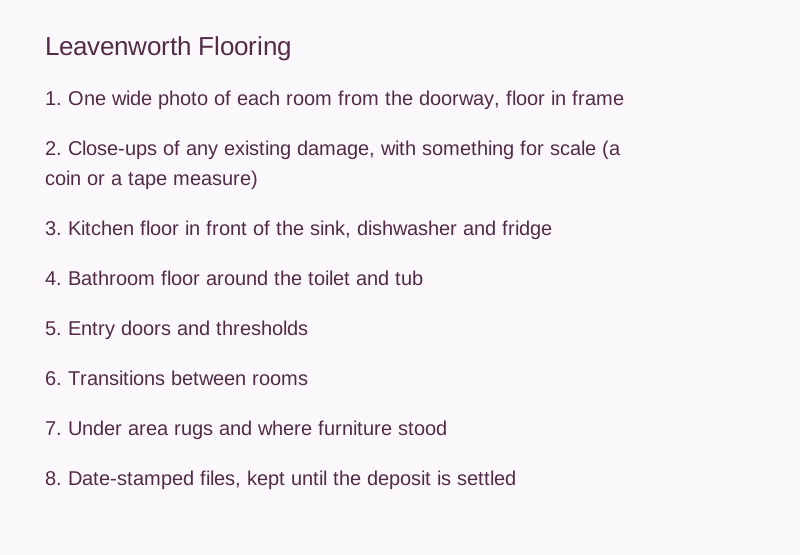
Photos taken the same way at the start and end of a lease settle most floor disagreements. A simple checklist for both landlords and tenants:
- One wide photo of each room from the doorway, floor in frame
- Close-ups of any existing damage, with something for scale (a coin or a tape measure)
- Kitchen floor in front of the sink, dishwasher and fridge
- Bathroom floor around the toilet and tub
- Entry doors and thresholds
- Transitions between rooms
- Under area rugs and where furniture stood
- Date-stamped files, kept until the deposit is settled
Timing
May through August is when Leavenworth's rentals turn over fastest. If you know your move-out date, send photos of the floor as soon as you can, so there is time to schedule the repair before the walkthrough rather than after it.
Sources
- K.S.A. 58-2550, security deposits
- U.S. Army, summer moving season
- U.S. Census Bureau, ACS 2024 five-year estimates, B25003 tenure
Get a Quote
Moving out, or turning a unit? Send photos of the floor and your date, and we will reply with a written repair quote.